





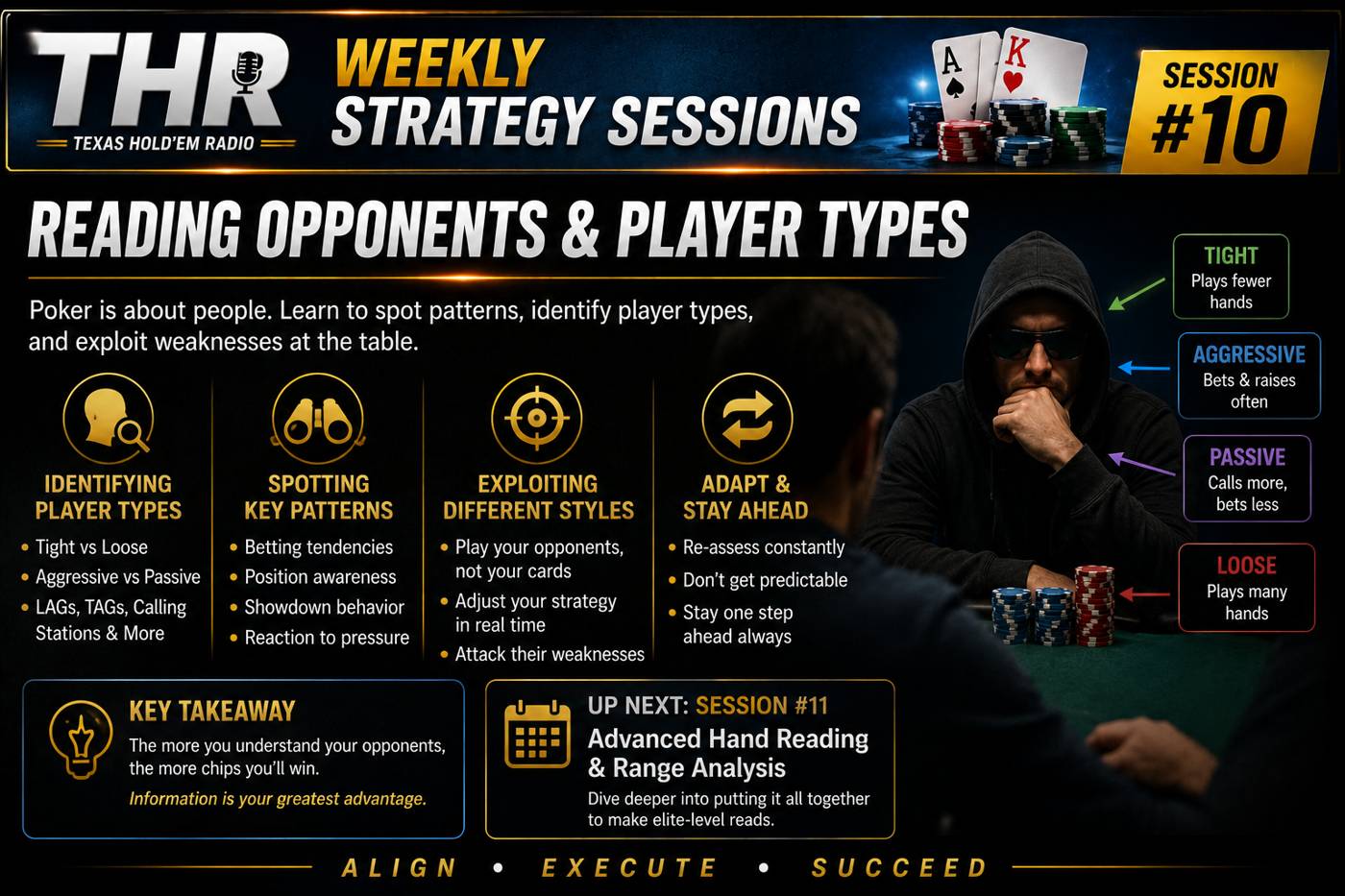
Strategy Session #10: Reading Opponents & Player Types
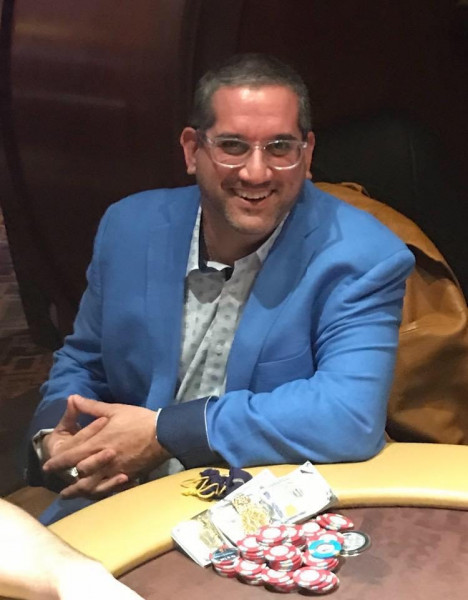
By: Hal Coblentz- Semi-Professional Cash Game Player 20+ years
🎙️ Texas Hold’em Radio
Session Overview
Poker is not just about the cards.
It’s about:
- Patterns
- Tendencies
- Pressure
- Psychology
The faster you identify what type of player you’re against, the faster you can exploit them.
Great poker players don’t simply play their own hands well…
They adjust to everyone else at the table.
🎯 Core Focus: Learning to Read the Table
1. Identifying Player Types
Every poker player falls into certain patterns.
🔹 Tight Players
- Play fewer hands
- Usually stronger holdings
- Easier to bluff in the right spots
🔹 Loose Players
- Play many hands
- Call too often
- Dangerous because they’re unpredictable
🔥 Aggressive Players
- Bet and raise frequently
- Apply pressure constantly
- Can force mistakes
🧊 Passive Players
- Call more than they bet
- Rarely bluff
- Usually have strength when showing aggression
🧠 The Four Main Player Styles
🟢 TAG (Tight Aggressive)
The strongest standard winning style.
- Selective starting hands
- Aggressive betting
- Difficult to exploit
👉 Respect their raises.
🔴 LAG (Loose Aggressive)
Very dangerous when skilled.
- Plays many hands
- Constant pressure
- Forces uncomfortable decisions
👉 Trap them with strong hands.
🟡 Calling Station
- Hates folding
- Calls too much
- Rarely bluffs
👉 Don’t bluff them. Value bet relentlessly.
🔵 Nit
- Extremely tight
- Avoids risk
- Folds too often under pressure
👉 Attack their blinds and apply aggression.
📊 Spotting Key Patterns
Pay attention to:
- Bet sizing
- Speed of action
- Position awareness
- Showdown hands
- Emotional reactions
🚨 Example:
Player suddenly bets huge after playing passively all night?
That often means:
👉 Real strength.
🚨 Another Example:
Player snap-checks flop and turn repeatedly?
Often weakness or surrender.
⚔️ Exploiting Different Styles
The secret:
👉 Adjust YOUR strategy based on THEIR tendencies.
Against Tight Players:
- Bluff more
- Steal blinds
- Pressure marginal holdings
Against Loose Players:
- Bluff less
- Bet bigger for value
- Let them make mistakes
🧠 Pro Tip (THR Edge)
Most players focus only on their own cards.
Elite players focus on:
- Who’s emotional
- Who’s scared
- Who’s tilting
- Who’s protecting chips
- Who’s trying to bully the table
Poker becomes much easier when you stop asking:
❌ “What do I have?”
…and start asking:
✅ “What do THEY have?”
📊 Quick Recap
🔥 Attack:
- Tight/passive players
- Scared money
- Predictable tendencies
⚠️ Be Careful Against:
- Skilled aggressive players
- Loose unpredictable opponents
- Players trapping quietly
🚀 What’s Next — Strategy Session #11
Advanced Hand Reading & Range Analysis
Next session we’ll break down:
- Putting opponents on ranges
- Narrowing possible hands street-by-street
- Combining board texture + betting patterns
- Making elite-level reads
👉 This is where poker shifts from guessing…
to calculated decision making.
🎯 Final THR Takeaway
The more information you gather at the table…
The less poker becomes gambling.
And the more it becomes strategy.
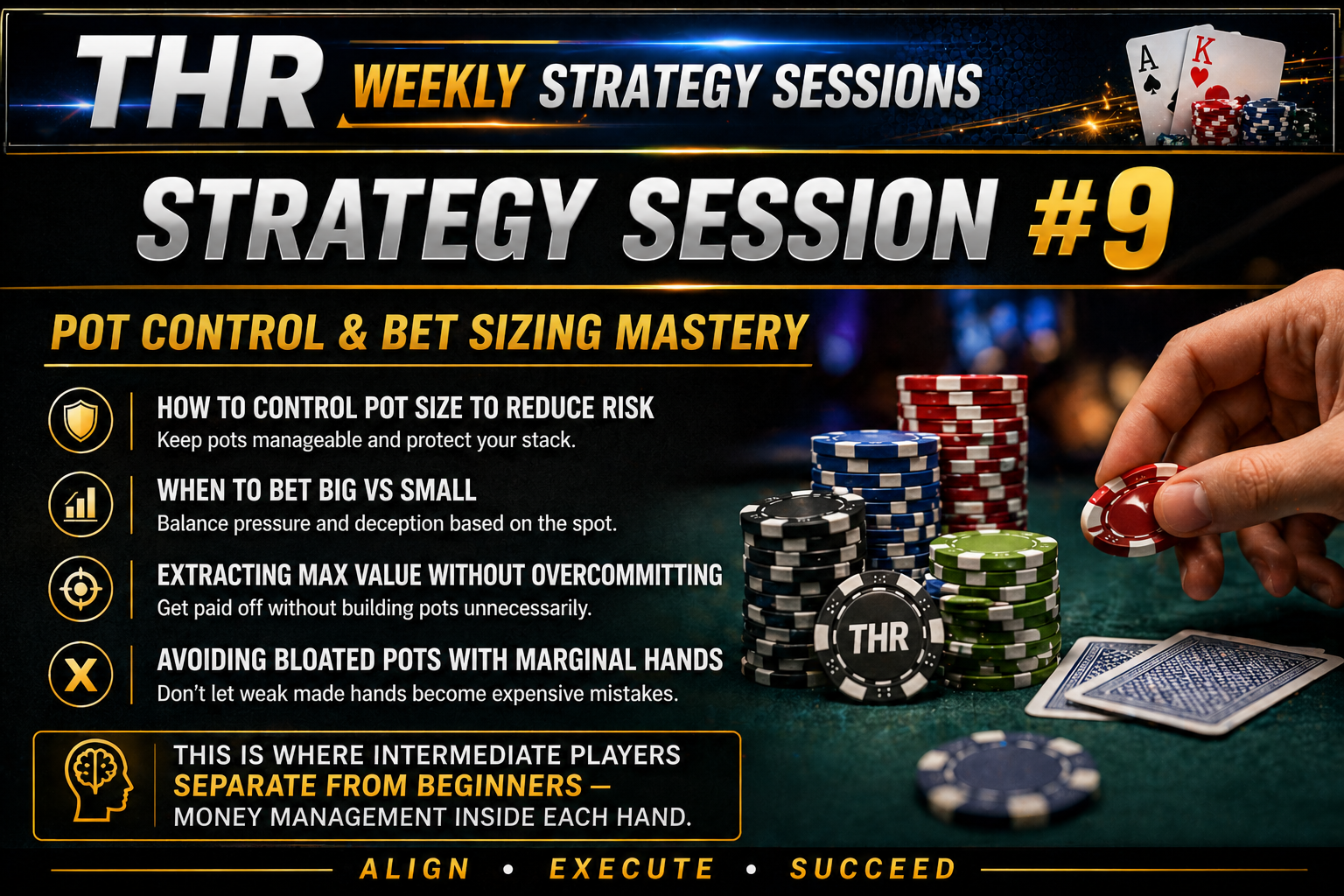
Poker Strategy Session #9
By: Hal Coblentz- Semi-Professional Cash Game Player 20+ years
🎙️ Texas Hold’em Radio
Strategy Session #9: Pot Control & Bet Sizing Mastery
🔥 Session Overview
This is where a lot of players quietly lose money.
Not because they play bad hands…
But because they build pots incorrectly.
Pot control and bet sizing is what separates:
👉 Players who survive
from
👉 Players who consistently profit
🎯 Core Focus: Controlling the Hand
1. 🧠 How to Control Pot Size to Reduce Risk
Pot control is about keeping the hand manageable when you're not holding a monster.
You want:
- Smaller pots with marginal hands
- Bigger pots with strong hands
✅ Ways to control the pot:
- Check back in position
- Call instead of raise
- Use smaller bet sizing
❌ Common mistake:
Players inflate pots with one-pair hands and get trapped later.
💡 Think:
“Do I want to play for stacks here?”
If the answer is no → control the pot.
2. 💰 When to Bet Big vs Small
Bet sizing is storytelling.
🔹 Bet BIG when:
- You have a strong value hand
- Board is wet (draw-heavy)
- You want to charge draws
🔹 Bet SMALL when:
- Board is dry
- You’re bluffing efficiently
- You want thin value
🎯 Simple Rule:
- Big bets = pressure + protection
- Small bets = control + efficiency
3. 🏆 Extracting Max Value Without Overcommitting
The goal is NOT just to win the hand…
It’s to win the most money possible without risking too much.
✅ Best practices:
- Build the pot gradually
- Let weaker hands stay in
- Avoid scaring off opponents too early
❌ Biggest leak:
Overbetting early → opponent folds → you win less
💡 Think:
“How do I keep worse hands calling?”
4. ⚠️ Avoiding Bloated Pots with Marginal Hands
This is where bankrolls disappear.
Hands like:
- Top pair weak kicker
- Middle pair
- Ace-high
These are NOT stack-off hands
🚫 Warning Signs You’re in Trouble:
- Pot is growing fast
- Opponent shows aggression
- You’re unsure where you stand
💡 Discipline move:
Check, call, or even fold — don’t force it
🧠 Pro Tip (THR Edge)
Great players don’t just play cards…
They control pot size relative to hand strength
👉 Weak hand = small pot
👉 Strong hand = big pot
Sounds simple — but this is where money is made.
📊 Quick Recap
Control the Pot When:
- You’re unsure
- You have marginal value
- You’re out of position
Build the Pot When:
- You have strong value
- Opponent can call worse
- You’re ahead of their range
🚀 What’s Next — Strategy Session #10
Session #10: Reading Opponents & Player Types
We’ll break down:
- Identifying tight vs loose players
- Spotting aggression patterns
- Exploiting different player styles
- Adjusting your strategy in real time
👉 This is where poker turns from cards… into people
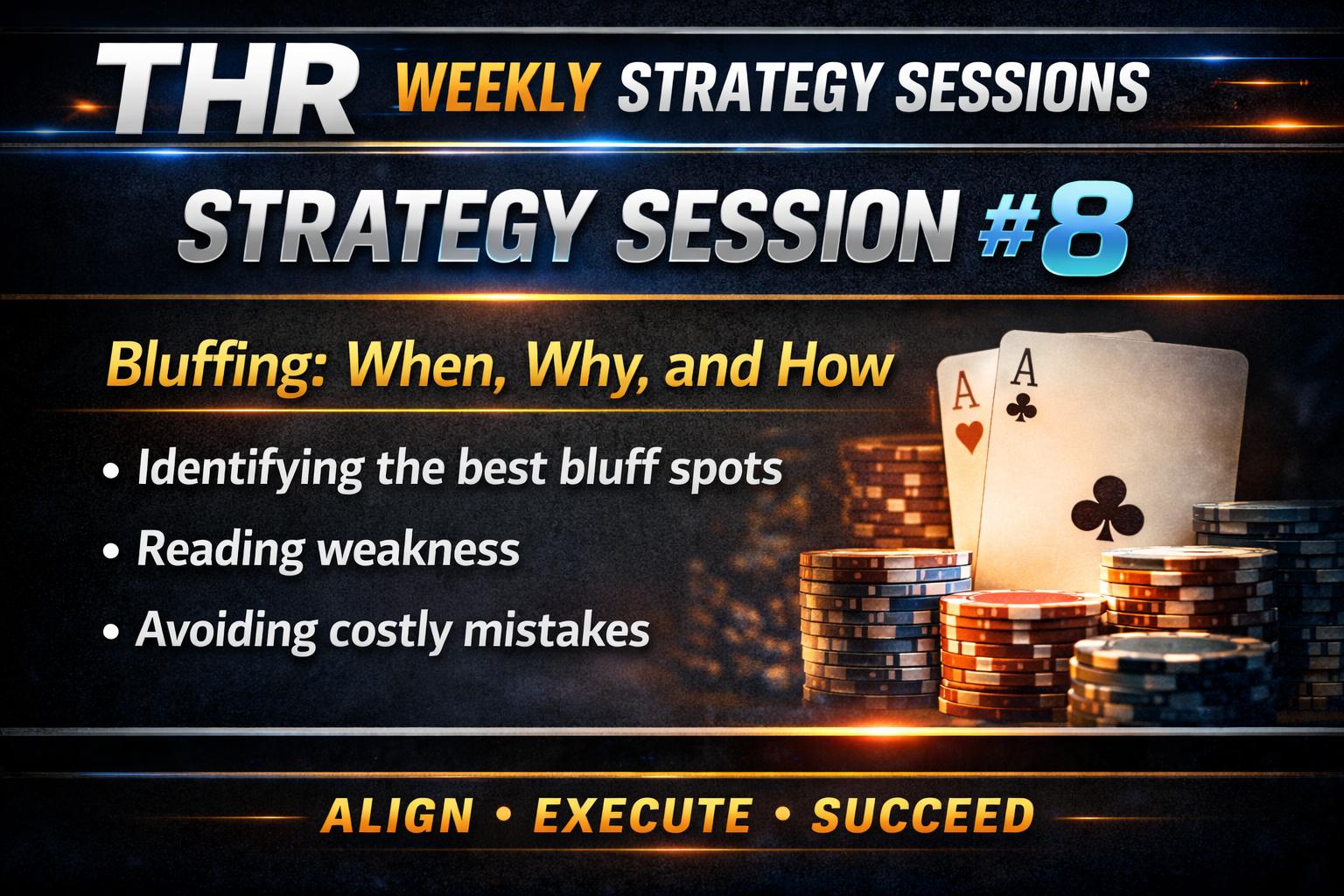
Poker Strategy Session #8
By: Hal Coblentz- Semi-Professional Cash Game Player 20+ years
🎙️ Texas Hold’em Radio
Strategy Session #8: Bluffing — When, Why, and How
🔥 Session Overview
Bluffing is one of the most misunderstood — and most powerful — weapons in poker. Most players bluff too often, in the wrong spots, or for the wrong reasons.
This session teaches you how to bluff with purpose, not emotion.
🎯 Core Focus: Bluffing with Intent
1. When to Bluff (Timing is Everything)
Bluff when:
- Your opponent shows clear weakness
- The board heavily favors your perceived range
- You can credibly represent a strong hand
- You are in position
✅ Best spots:
- Heads-up pots
- Late position vs blinds
- After opponent checks twice (check/check lines)
❌ Avoid bluffing:
- Multi-way pots
- Calling stations
- Players who “don’t like folding”
2. Why You Bluff (The Real Purpose)
Bluffing is not about “getting lucky” — it’s about forcing folds from better hands.
Strong reasons to bluff:
- To balance your value hands
- To apply pressure in +EV spots
- To exploit tight or scared players
- To win pots you would otherwise lose
👉 Think like this:
“What better hands am I trying to make fold?”
3. How to Bluff (Execution Matters)
🔍 Identify the Best Bluff Spots
- Dry boards (A♣ 7♦ 2♠)
- Scare cards (overcards, flush completes)
- Opponent hesitation (long tanks, passive play)
👀 Reading Weakness
Look for:
- Check-check patterns
- Small, unsure bets
- Sudden passivity from aggressive players
These are green lights 🚦
⚠️ Avoiding Costly Mistakes
Common leaks:
- Bluffing just because “you missed”
- Bluffing into multiple players
- Over-bluffing rivers
- Ignoring player type
💡 Golden Rule:
Bad players call too much — don’t bluff them.
🧠 Pro Tip (THR Edge)
The best bluffs tell a consistent story.
If your line doesn’t make sense… good players will sniff it out instantly.
📊 Quick Recap
Bluff More When:
- Opponent is tight
- You have position
- Board favors your range
Bluff Less When:
- Opponent is loose
- Pot is multi-way
- You’re out of position
🎯 What’s Next — Strategy Session #9
Session #9: Pot Control & Bet Sizing Mastery
We’ll break down:
- How to control pot size to reduce risk
- When to bet big vs small
- Extracting max value without overcommitting
- Avoiding bloated pots with marginal hands
👉 This is where intermediate players separate from beginners — money management inside each hand.
Texas Holdem Radio
Poker Strategy Session #7
By: Hal Coblentz- Semi-Professional Cash Game Player 20+ years
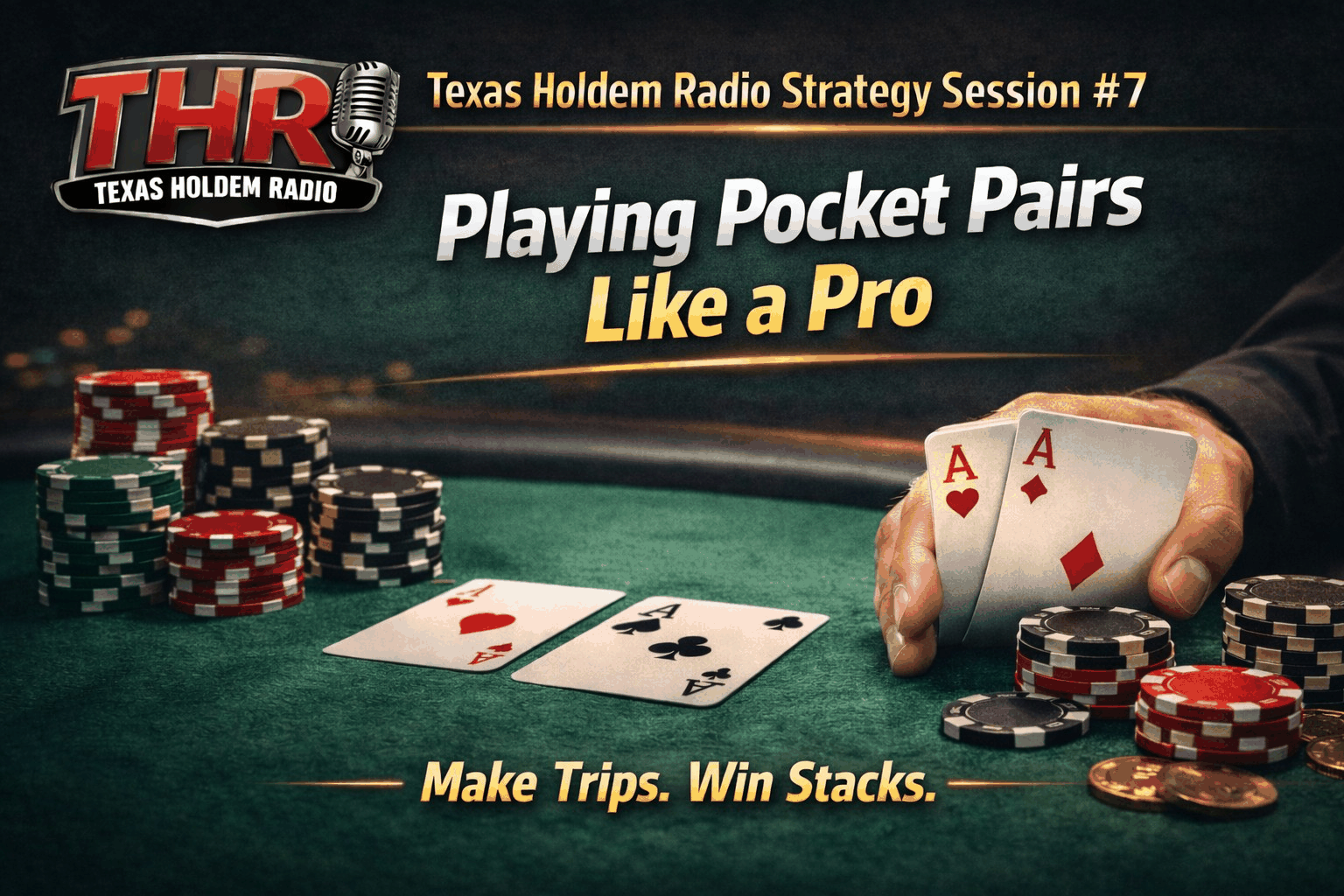
Playing Pocket Pairs Like a Pro
Pocket pairs are one of the most misunderstood hands in poker.
From pocket deuces to pocket aces, knowing how to properly play them can dramatically increase your win rate.
This session breaks down exactly how to play pocket pairs at every stage.
What Are Pocket Pairs?
A pocket pair is when you are dealt:
AA, KK, QQ… all the way down to 22.
These hands fall into three main categories:
1. Premium Pairs
AA, KK, QQ
2. Medium Pairs
JJ – 77
3. Small Pairs
66 – 22
Each category requires a completely different strategy.
How to Play Premium Pairs (AA, KK, QQ)
These are your money makers.
Pre-Flop Strategy:
✔ Always raise
✔ Re-raise aggressively (3-bet)
✔ Build the pot
Goal:
Get value, not get tricky
Common mistake:
Slow playing too often.
👉 Don’t get cute. Charge your opponents.
How to Play Medium Pairs (JJ – 77)
These are danger zone hands.
They are often:
- ahead pre-flop
• but vulnerable post-flop
Pre-Flop:
✔ Raise in most positions
✔ Be cautious facing big re-raises
Post-Flop:
Ask yourself:
“Did this flop help my opponent more than me?”
Example:
You have: 99
Flop: K♦ Q♣ 5♠
👉 You’re likely behind.
How to Play Small Pairs (66 – 22)
These hands are best used for:
Set Mining
That means:
Calling pre-flop hoping to hit three of a kind (a set).
Key Rule:
You should have at least 10x–15x the call amount in effective stack behind.
Example:
Call $10 → opponent should have $100–$150 behind
When You Hit a Set
This is where you make your money.
Strategy:
✔ Play aggressively
✔ Build the pot early
✔ Don’t slow play too much
Why?
Because:
- draws can catch up
• scare cards can kill action
👉 Get paid while you’re ahead.
When You Miss the Flop
Most of the time… you will.
If you don’t hit your set:
✔ Fold to aggression
✔ Don’t get attached to the hand
✔ Avoid “hope calling”
Position Matters
Pocket pairs play MUCH better:
✔ In late position
✔ When you control the action
✔ Against fewer opponents
The earlier your position, the more cautious you should be.
Quick Strategy Tips
✔ Raise premium pairs aggressively
✔ Don’t overvalue medium pairs
✔ Set mine small pairs
✔ Fold when you miss and face pressure
✔ Always consider stack sizes
Pro Insight
Great players don’t just look at their pair…
They think:
“How strong is my pair relative to this board?”
A pair of 9’s can be:
- very strong pre-flop
• completely worthless post-flop
Context is everything.
Coming Next Session
Strategy Session #8
Bluffing: When, Why, and How
- Identifying the best bluff spots
• Reading weakness
• Avoiding costly mistakes
Texas Holdem Radio
Play. Learn. Compete. Connect.
Texas Holdem Radio
Poker Strategy Session #6
By: Hal Coblentz- Semi-Professional Cash Game Player 20+ years
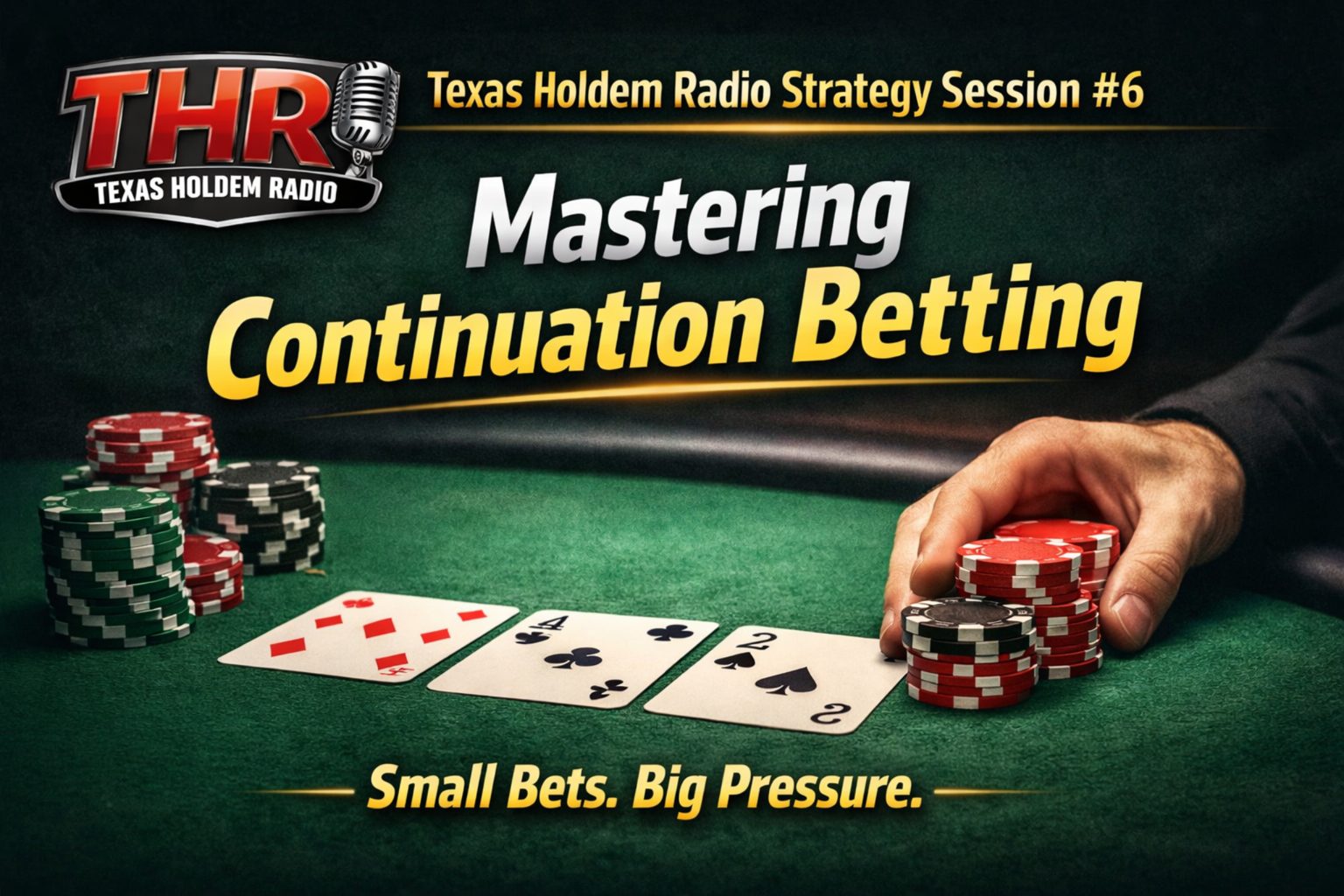
Mastering Continuation Betting (C-Bets)
One of the most powerful weapons in modern poker strategy is the continuation bet, commonly called a C-Bet.
If you raised before the flop and then bet again on the flop, you are making a continuation bet — continuing the story that you have the strongest hand.
Learning when to C-Bet, how much to bet, and when to give up separates average players from consistently winning players.
What Is a Continuation Bet?
A continuation bet occurs when:
- You raise pre-flop
- One or more players call
- You bet again on the flop
The logic is simple:
You represented strength pre-flop.
The flop bet reinforces that story.
Most of the time your opponents miss the flop, meaning they fold a large percentage of hands.
Why C-Bets Work
Even strong starting hands only hit the flop about 1/3 of the time.
Example:
You raise with:
AK
Flop comes:
9♦ 4♣ 2♠
You likely missed — but so did your opponent.
Because you showed strength pre-flop, your opponent often assumes you have:
AA
KK
AK
AQ
or an overpair.
That pressure forces folds.
Good Boards to C-Bet
Certain flops strongly favor the pre-flop raiser.
Examples:
Dry Boards
A♣ 7♦ 2♠
K♦ 8♣ 3♥
These boards are hard for callers to connect with.
These are excellent spots to C-Bet nearly every time.
Dangerous Boards to Be Careful
Some flops hit the caller's range better.
Examples:
9♠ 8♠ 7♦
J♥ T♥ 9♣
These boards are:
- connected
• draw heavy
• dangerous for bluffs
In these situations, consider:
- checking
• pot controlling
• choosing smaller bets
Optimal C-Bet Sizing
A common mistake is betting too large.
Typical strong C-Bet sizes:
1/3 pot
or
1/2 pot
Smaller bets accomplish the same goal:
They apply pressure while risking fewer chips.
Remember:
Poker is about risk vs reward.
When to Give Up
Even the best players don't fire multiple barrels blindly.
Warning signs:
- multiple callers
• coordinated boards
• aggressive opponents
Sometimes the best play is simply:
Check and move on.
Saving chips is just as important as winning pots.
Quick Strategy Tips
✔ C-Bet more when heads-up
✔ C-Bet more on dry boards
✔ Use smaller bet sizes
✔ Avoid bluffing into multiple players
✔ Pay attention to opponent tendencies
Pro Insight
The best players are not just betting randomly.
They are constantly asking:
“Does this board favor my range or my opponent's range?”
Once you start thinking in terms of ranges instead of cards, your strategy will level up quickly.
Coming Next Session
Strategy Session #7
Playing Pocket Pairs Like a Pro
- When to set mine
• When to fold small pairs
• How to extract maximum value
Texas Hold’em Radio – Weekly Strategy Session
Week 5 – 2026
By: Hal Coblentz- Semi-Professional Cash Game Player 20+ years

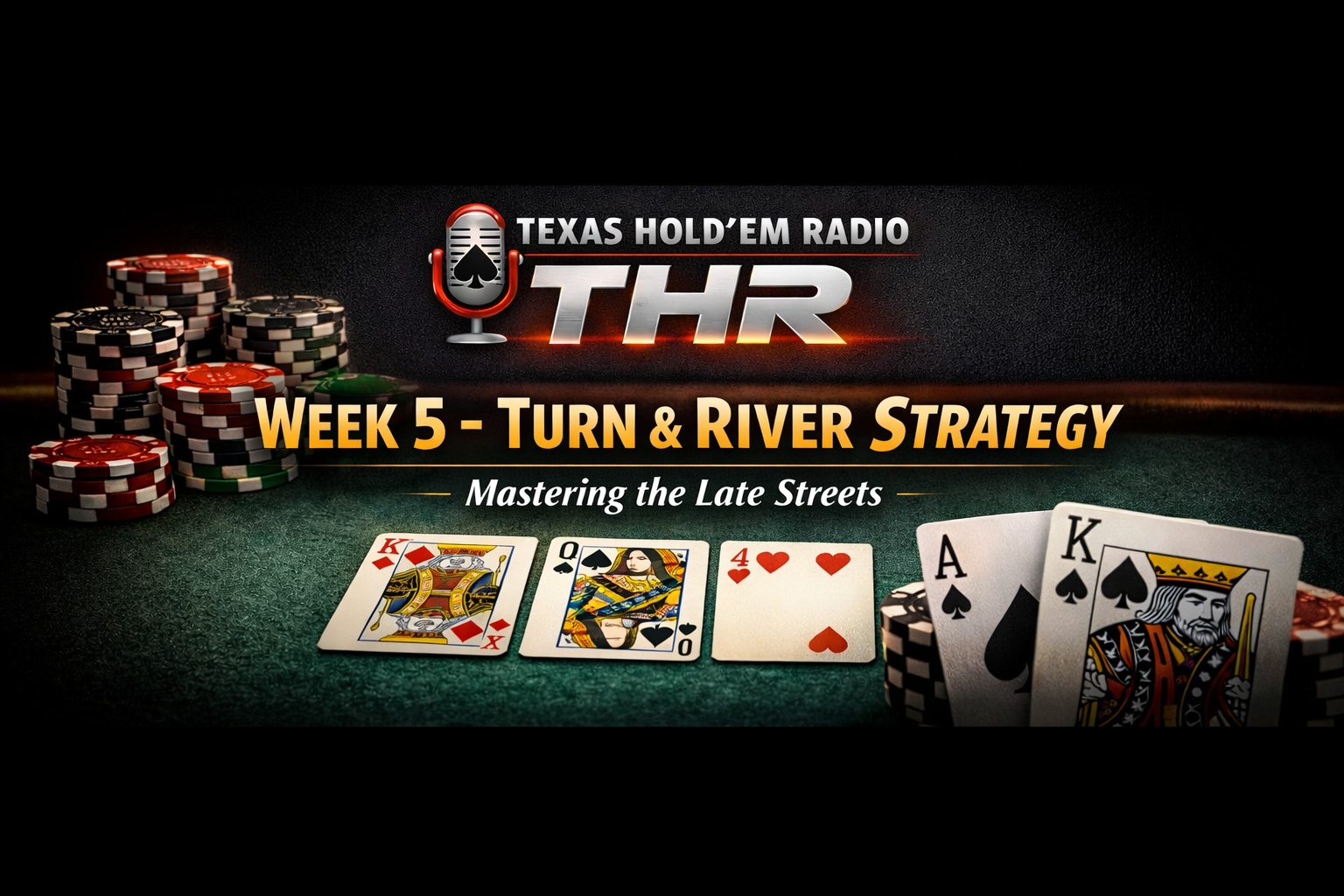
If Week 4 was about continuation betting, Week 5 is where we separate the button-clickers from the thinkers.
This week I’m focusing on Turn & River decision-making — where most money is actually won (or punted).
A lot of players play the flop fine… and then completely lose the plot when the board changes or pressure ramps up. Let’s fix that.
Big Idea for Week 5
👉 Every turn and river decision must answer ONE question:
Am I betting for value, protection, or as a bluff — and what worse hands continue?
If you can’t answer that instantly, checking is often the better play.
1. Turn Play: The Truth Card
The turn is where ranges start to narrow and mistakes get expensive.
When to Fire the Turn
I double-barrel the turn when:
- The turn improves my perceived range (overcards, scare cards, range cards)
- I have equity + fold equity
- I’m still getting value from worse hands
Example – Cash Game
- You raise CO with A♠ K♠
- BB calls
- Flop: K♦ 7♣ 2♠ → you c-bet, BB calls
- Turn: Q♠
This is a beautiful turn.
- You pick up nut-flush equity
- You block strong Kx
- Worse hands (KJ, KT, 7x, flush draws) still continue
Bet again.
When to Slow Down
I check turns when:
- The turn smashes villain’s range
- I’m against sticky calling stations
- My hand has showdown value but hates a raise
Remember: checking doesn’t mean weakness — it often means control.
2. River Play: Value > Ego
Rivers are where players either print… or light money on fire.
Value Betting the River
Ask yourself:
- What worse hands realistically call?
- How thin is too thin against this opponent?
Example – Tournament Spot
- You raise with Q♠ Q♦
- Board runs: Q♣ 9♠ 6♠ 4♥ 2♦
You have top set.
If your opponent can call with:
- Overpairs? No.
- Two pair? Rare.
- Missed draws? No.
This is a small value bet or a check, not an ego shove.
Great players don’t size for how strong they feel — they size for how weak the caller is.
3. Bluffing Rivers (The Adult Version)
River bluffs should be:
- Credible
- Blocker-based
- Opponent-specific
I bluff rivers when:
- I block the nuts
- The story makes sense from preflop → river
- My opponent can actually fold
If you’re bluffing a calling station, that’s not strategy — that’s charity.
4. Bet Sizing: Stop Using One Size
Turn & river sizing matters more than flop sizing.
My Simple Framework
- Small bets (25–40%) → thin value, cheap bluffs
- Medium bets (50–70%) → strong value, pressure
- Big bets / overbets → polarized (nuts or air)
If you’re betting big without polarization, you’re begging to get paid wrong or snapped off.
Week 5 Homework
Before you click “bet” on the turn or river, force yourself to say:
- What am I representing?
- What hands call?
- What hands fold?
- Am I happy if I get raised?
If you don’t like the answers — check.
Final Thought
Flops are flashy.
Turns build pots.
Rivers decide winners.
Master turn and river play, and your win-rate jumps immediately — in cash games, tournaments, and especially live poker where players hate folding late.
Next week, I’ll dive into Week 6: Board Texture & Range Advantage — how to know who the board actually favors before you put a chip in the pot.
See you at the tables,
Hal ♠️
🎙️ Weekly Poker Strategy Coaching
Week 4 – 2026
Continuation Betting: When to Fire, When to Slow Down
By: Hal Coblentz- Semi-Professional Cash Game Player 20+ years
By now, we’ve talked about hand selection, discipline, and position. This week is where I see the biggest mistakes — and the biggest opportunities.
Continuation betting, or c-betting, is one of the most misunderstood concepts in poker. Some players c-bet every flop. Others never do. Both are wrong.
A continuation bet isn’t automatic.
It’s intentional.
What a Continuation Bet Really Is
A continuation bet is simply this:
I raised preflop, and I bet the flop.
That’s it.
But why I bet the flop matters more than the fact that I raised preflop.
I’m asking myself:
- Who does this board favor?
- What am I representing?
- How many players am I against?
- Do I have equity if called?
If I don’t know the answer to those questions, I shouldn’t be betting.
When I Almost Always C-Bet
Dry, Disconnected Boards
Boards like:
- K♣ 7♦ 2♠
- A♦ 9♠ 4♣
- Q♠ 6♦ 3♣
These flops miss most calling ranges. Even when I miss, I’m still representing strength.
In heads-up pots, I’ll c-bet these boards often, even with nothing.
When I Have Range Advantage
If I raise from late position and get called by the blinds, many flops favor me — even if I miss.
Why?
- I have more strong aces
- I have more big pairs
- I have more broadways
That’s not ego — that’s math.
When I Slow Down (And Save Money)
Wet, Connected Boards
Boards like:
- 9♠ T♠ J♦
- 8♦ 9♦ T♣
- 6♠ 7♠ 8♥
These boards smash calling ranges. When I c-bet blindly here, I’m lighting chips on fire.
Unless I have strong equity or a real plan, I often check these boards.
Multiway Pots
This is huge.
The more players in the pot, the less I c-bet. Someone usually has something.
Heads-up? I apply pressure.
Three or four players? I tighten way up.
Hand Example #1: Standard C-Bet
I raise from the cutoff with A♠ K♦
Big blind calls.
Flop: K♣ 7♦ 2♠
This is a slam-dunk c-bet.
- I hit top pair
- Board is dry
- My opponent checks
I bet for value and protection.
Hand Example #2: Missed Flop, Still a Bet
I raise on the button with Q♠ J♠
Big blind calls.
Flop: A♦ 6♣ 2♠
I missed — but this is still a great c-bet.
- Ace favors my range
- Board is dry
- One opponent
If he folds, I win immediately. If he calls, I reassess.
Hand Example #3: Knowing When to Check
I raise with A♦ Q♦
Two callers.
Flop: T♦ 9♠ 8♣
Even though I have overcards and a backdoor draw, this board is dangerous.
I often check here.
- Too many strong draws out there
- Multiway pot
- I don’t need to force action
Checking isn’t weakness — it’s control.
Biggest C-Bet Mistakes I See
- C-betting every flop automatically
- Betting wet boards with no equity
- Betting multiway pots too often
- Firing turn barrels without a plan
A continuation bet should tell a believable story. If it doesn’t, good players will punish you.
My C-Bet Rule of Thumb
Before I bet the flop, I ask:
“What am I trying to accomplish?”
If the answer is “because I raised,” I check.
Week 4 Player Challenge
This week, I want you to:
- Track every c-bet you make
- Note board texture (dry vs wet)
- Record results when checked vs bet
You’ll be shocked how much money you save by checking more.
Coming Up Next Week
In Week 5, I’ll dive into Turn Play & Double Barrels — when to keep applying pressure and when to shut it down before things get expensive.
Until then:
Bet with purpose.
Check with confidence.
And remember — not every flop belongs to you. ♠️🔥
🎙️ Weekly Poker Strategy Coaching
Week 3 – 2026
Position Is Power: Playing Fewer Hands, Winning Bigger Pots
By: Hal Coblentz- Semi-Professional Cash Game Player 20+ years
Below is Texas Hold’em Radio – Poker Strategy Week 3, written in first person, ready to post. I’ve also included a visual header image concept (image group) that matches the strategy theme and can be turned into a 4K branded header file on request.
🃏 Poker Strategy – Week 3
Position Is Power: Playing Fewer Hands, Winning Bigger Pots
Week 3 Focus
If there’s one concept I wish every player truly understood early, it’s this:
Position is everything.
I don’t care how pretty your cards look—if you’re out of position, you’re fighting an uphill battle. This week, I want you to start winning before the flop by simply choosing better spots based on where you’re sitting at the table.
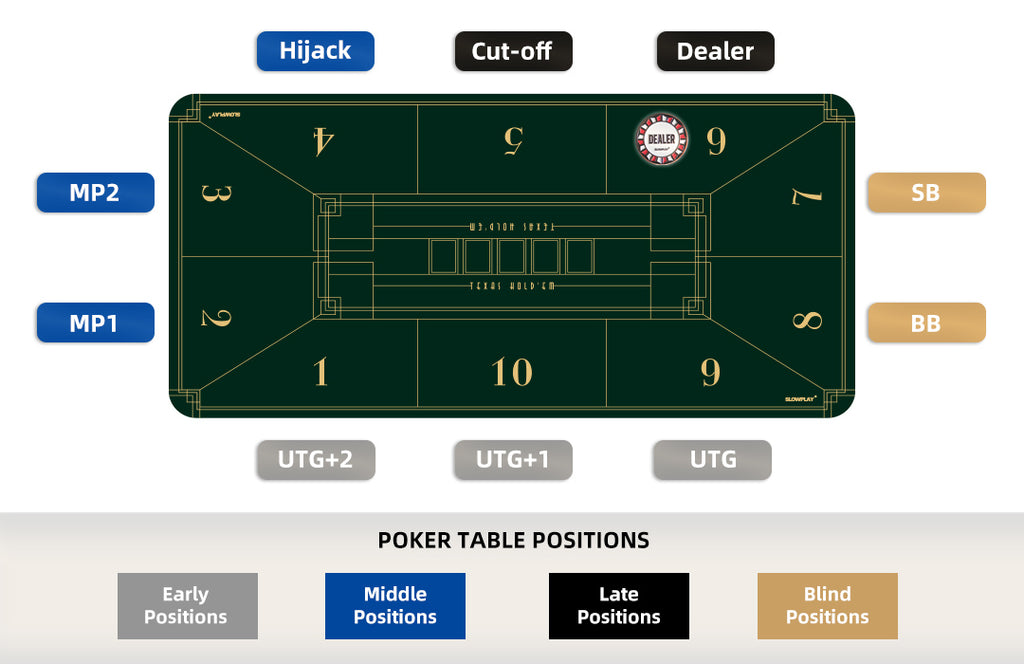
🔁 What Position Really Means
Position is about who acts last on every betting street.
- Early Position (EP): Under the Gun (UTG, UTG+1)
- Middle Position (MP): The bridge between danger and opportunity
- Late Position (LP): Cutoff (CO) and Button (BTN)
- Blinds: Worst seats post-flop, period
The later you act, the more information you have—and information wins money.
🎯 My Core Rule
I play fewer hands early, more hands late, and aggressively protect my late position.
If you apply just that rule consistently, your win rate improves immediately.
📊 Preflop Hand Selection by Position (Live Games)
Early Position (Tight & Disciplined)
Hands I’m opening:
- AA–TT
- AK, AQ (sometimes AJs)
- KQs
Hands I’m not opening:
- Small pairs (unless table is passive)
- Suited connectors
- Weak aces
Early position mistakes are expensive because you’ll be first to act every street.
Middle Position (Controlled Expansion)
Hands I add:
- 99–77
- AJs–ATs
- KQs, QJs
- Occasional suited connectors (98s+)
I’m still cautious, but now I can observe how tight or loose the table really is.
Late Position (Where I Make My Money)
Hands I add:
- Any pocket pair
- Most suited aces
- Broadways
- Suited connectors & one-gappers
- Occasional steals with blockers
On the button, I’m not just playing cards—I’m attacking ranges.
🧠 Hand Example #1 – Cash Game ($1/$3)
I’m on the Button with A♠9♠.
Two limpers ahead of me.
This is a mandatory raise.
Why?
- I have position
- I isolate weaker players
- I control pot size
- I can steal later streets
I raise to $20.
Blinds fold. One limper calls.
Flop: K♠7♠2♦
This hand prints money because:
- I have position
- Nut flush draw
- Fold equity
I continuation bet, knowing I can win the pot now or later.
🧠 Hand Example #2 – Tournament Spot
Middle stages of a tournament.
I’m in Early Position with K♦J♦.
This is a fold for me.
Same hand on the Button?
It’s a raise or even a 3-bet depending on stacks.
Same cards. Different position. Completely different strategy.
⚠️ Common Position Mistakes I See
- Limping early with speculative hands
- Calling raises out of position “to see a flop”
- Playing the same range from every seat
- Ignoring the button’s power
If you’re losing money, odds are you’re overplaying hands from bad seats.
🔥 Week 3 Assignment
For the next week:
- Track how many hands you play from early position
- Open wider only from the button and cutoff
- Avoid calling raises out of position
- Raise more—don’t limp late
You don’t need better cards.
You need better seats.
🎙️ Final Thought
Great poker players don’t just play hands—they play positions, people, and pressure.
Once you respect position, the game slows down, decisions get clearer, and your bankroll lasts longer.
Next week, I’ll break down bet sizing and why most players bet too small when it matters most.
— Hal
TexasHoldemRadio.com
_______________________________________________________________________________________________________________________
🎙️ Weekly Poker Strategy Coaching
Week 2 – 2026
Continuation Betting: When I Fire, When I Slow Down, When I Shut It Down
By: Hal Coblentz- Semi-Professional Cash Game Player 20+ years
Welcome back to my weekly poker strategy series on Texas Hold’em Radio.
Last week, I talked about playing fewer hands and respecting position. This week builds directly on that foundation—because once you start entering pots with better hands and better intent, the next big question becomes:
What do I do on the flop?
Specifically—should I continuation bet?
🃏 What a Continuation Bet Really Is
A continuation bet (c-bet) is when I raise preflop and then bet again on the flop.
Simple definition.
But the decision is anything but automatic.
One of the most expensive habits I see is players c-betting just because they were the preflop raiser. I don’t bet out of habit—I bet with a reason.
🧠 My Rule: I C-Bet With a Plan
Before I put chips in on the flop, I ask myself three questions:
- Does this board favor my range?
- Who is my opponent and will they fold?
- What am I doing if I get called or raised?
If I don’t like the answers, I slow down—or I shut it down completely.
📊 Boards I Like to C-Bet
I c-bet more often on boards that:
- Are dry and disconnected
- Favor high cards
- Miss most calling ranges
Examples:
- A♣ 7♦ 2♠
- K♠ 8♦ 3♣
- Q♦ 5♠ 2♥
These boards allow me to represent strong hands credibly—even when I miss.
📉 Boards I Often Check
I check more often on boards that:
- Are coordinated
- Smash calling ranges
- Create multi-street danger
Examples:
- 9♠ 8♠ 7♦
- T♥ J♦ Q♠
- 6♣ 5♣ 4♥
On these boards, firing blindly just burns money.
🃏 Hand Examples – How I Play These Spots
Cash Game Example #1 – Standard C-Bet
Game: $1/$2 NLH
Position: Button
Hand: A♠ K♣
Action: I raise preflop, big blind calls
Flop: K♦ 7♣ 2♠
My Play: ➜ C-bet small (⅓ pot)
Why:
- I have top pair
- Board favors my range
- I get value from worse kings and pocket pairs
This is a clean, profitable c-bet.
Cash Game Example #2 – When I Slow Down
Hand: A♣ Q♣
Position: Cutoff
Flop: J♠ T♠ 9♦
My Play: ➜ Check
Why:
- Board smashes the caller’s range
- Too many draws and made hands
- Betting doesn’t fold better or get called by worse
This is a spot where discipline saves money.
Tournament Example #1 – Leveraging Fold Equity
Blinds: 500 / 1,000
Stack: 35 BB
Position: Button
Hand: K♠ Q♠
Flop: A♦ 6♣ 2♥
My Play: ➜ Small c-bet
Why:
- Ace-high board favors my range
- Opponent misses often
- Fold equity is high
I don’t need a hand—I need a believable story.
Tournament Example #2 – When I Shut It Down
Hand: 9♣ 9♦
Position: Middle Position
Flop: Q♠ J♦ T♣
My Play: ➜ Check and re-evaluate
Why:
- Board is terrible for my hand
- Too many turn cards make things worse
- Pot control keeps my stack intact
Sometimes the best bet is no bet.
🎯 Key Takeaways
- I don’t c-bet automatically
- I bet when the board, opponent, and situation line up
- Checking is not weakness—it’s strategy
- Protecting my stack is just as important as building it
📊 Your Homework This Week
Next time you raise preflop and see a flop, pause and ask:
- Who does this board really favor?
- What am I trying to accomplish with this bet?
- What’s my plan if I get called?
You’ll be amazed how quickly your decisions improve.
🔜 Coming Up Next Week
Week 3: Pot Control & Bet Sizing
Why I don’t build big pots with medium hands—and how bet size shapes outcomes.
Let’s keep playing smarter poker.
🃏🎙️ Texas Hold’em Radio
🎙️ Weekly Poker Strategy Coaching
Week 1 – 2026
Play Fewer Hands. Play Them Better
By: Hal Coblentz- Semi-Professional Cash Game Player 20+ years
Welcome to Week 1 of 2026 and the launch of my Weekly Poker Strategy Coaching Series here on Texas Hold’em Radio.
Each week, I’ll be sharing practical poker strategy—real-world concepts you can actually apply at the table. This isn’t about fancy solver talk or overcomplicating the game. It’s about thinking clearly, playing disciplined poker, and making better decisions consistently.
If you follow this series week after week, you’ll tighten up your fundamentals, eliminate common leaks, and start approaching the game with more confidence and purpose.
And we’re starting with the most important concept in poker—the one I see players ignore every single day.
🃏 Week 1 Strategy Session
Play Fewer Hands — Play Them Better
The biggest mistake I see from losing and breakeven players isn’t what they do after the flop.
It’s the hands they choose to play in the first place.. (I experienced this tonight as a matter of fact at Hustler Casino, Los Angeles )
Poker is not a game of constant action. It’s a game of patience, selection, and timing. Every hand you enter is an investment, and too many players invest in hands that simply don’t make money over time.
If you want to improve quickly, start here.
🔑 Position Is Everything
One of the first things I learned—and one of the last things many players truly respect—is position.
Your seat at the table should dictate how many hands you play.
Early Position (UTG / UTG+1)
When I’m first to act, I play tight and disciplined.
Hands I’m comfortable opening:
- AA–TT
- AK, AQ
- Occasionally AJs or KQs, depending on the table
If I’m unsure, I fold. Early position mistakes are costly and put you in tough spots for the rest of the hand.
Middle Position
From middle position, I can widen slightly—but control still matters.
Hands I’ll consider:
- 99–77
- AJ, ATs
- KQs, QJs
- Select suited connectors like 98s
I still avoid weak offsuit hands and “hope poker.”
Late Position (Button & Cutoff)
This is where I make a lot of my money.
Late position gives me:
- More information
- More stealing opportunities
- More control over pot size
Hands that are folds up front become profitable here because position gives you leverage.
🛑 I Don’t Limp
This is one habit I eliminated years ago—and my results improved immediately. Poker Pro Susie Asaacs who I met early in my poker life said something to me that always stuck. "If you can't raise, fold" is what she said. It really stuck with me and to this day if a hand isn’t good enough for me to raise, it usually isn’t good enough to play.
Limping:
- Invites multi-way pots
- Eliminates fold equity
- Forces you into guessing games post-flop
I raise with a plan—or I fold.
🧠 I Think in Ranges, Not Just Cards
I don’t ask myself:
“Do I have the best hand?”
I ask:
“How does my hand perform against my opponent’s range?”
Once you start thinking this way, poker becomes clearer and less emotional. You stop chasing hands and start making profitable decisions.
🃏 Hand Examples – How I Play These Spots
Cash Game Example #1 ($2/$3 NLH)
Position: UTG
Hand: K♠ J♦
My Play: ➜ Fold
Even though the hand looks decent, it’s dominated too often and puts me in bad spots out of position. This is an easy fold for me every time.
Cash Game Example #2 (Late Position)
Position: Button
Hand: A♣ 9♣
Action: Folds to me
My Play: ➜ Raise 2.5–3x
Now the same concept changes completely. I have position, fold equity, and strong draw potential. This is a profitable open for me.
Tournament Example #1 (Early Levels)
Blinds: 100 / 200
Stack: 40 BB
Position: UTG+1
Hand: 6♠ 6♦
My Play: ➜ Small raise or fold depending on the table
Early in tournaments, I don’t force action. Small pairs play best heads-up, and I’m focused on stack preservation—not gambling.
Tournament Example #2 (Mid Stages)
Blinds: 1,000 / 2,000
Stack: 22 BB
Position: Cutoff
Hand: Q♠ J♠
My Play: ➜ Open raise
This is a spot where pressure matters. I still have fold equity, position, and a hand that plays well post-flop. These are the spots where tournaments are actually won.
📊 Your Homework This Week
This strategy works whether you are playing live or online like many of our listeners. :
- Pay attention to how many hands you play
- Note your position when you enter pots
- Be honest about hands you knew you shouldn’t have played
Awareness alone will improve your game.
🎯 Final Thought
Poker rewards patience, discipline, and clarity.
I don’t win by playing more hands.
I win by playing better hands, in better spots, for better reasons.
Next week, I’ll break down Continuation Betting—when I fire, when I slow down, and when I shut it down completely.
Welcome to 2026!
Let’s play smarter poker.
Texas Hold’em Radio